
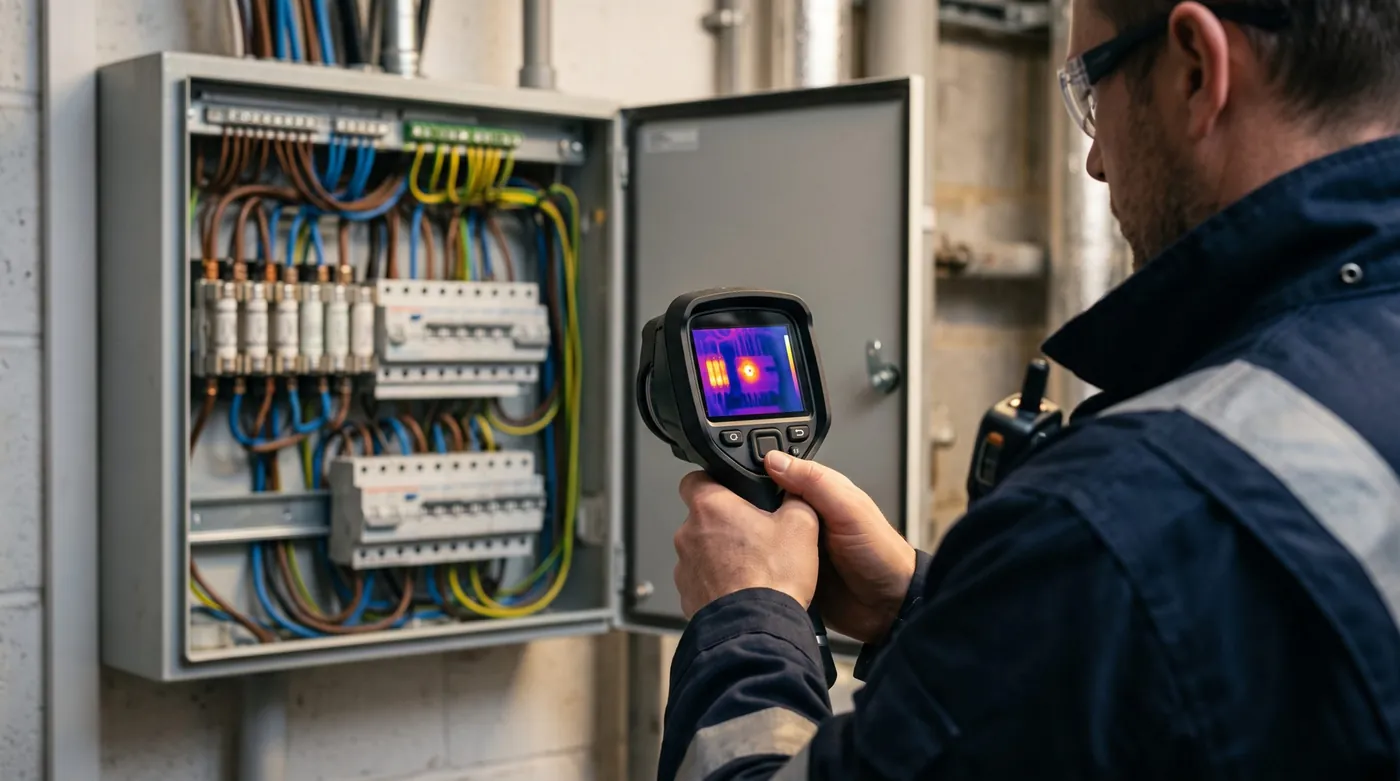
A thermal imaging survey finds loose or corroded connections while they are still a maintenance job rather than an emergency. A bad connection heats up long before it fails. You cannot see that heat, and a standard test will not always reveal it, but a thermal imaging camera can.
How thermal imaging works
An infrared camera detects surface temperature and turns it into an image. In an electrical installation, a poor connection has higher resistance, so it runs hotter than the connections around it. On a thermal image, that shows up as a clear hot spot.
The survey is carried out with the installation running under normal load. That matters, because a fault that is invisible with the power off often shows up only when current is flowing.
What gets surveyed
- Main switchgear and distribution boards
- Busbars and busbar joints
- Motor control centres and motor connections
- Isolators, contactors and terminations
- Large cable terminations and sub-mains
What a survey can find
- Loose or corroded connections
- Overloaded circuits and undersized cables
- Unbalanced loads across the three phases
- Failing protective devices running hotter than their neighbours
How it fits with an EICR
Thermal imaging does not replace an Electrical Installation Condition Report. An EICR tests the installation against the wiring regulations. A thermal survey looks for heat that indicates a developing problem under real operating conditions.
Used together, they give a much fuller picture, and the thermal survey is particularly useful in the years between EICRs. Think of it as a health check between full inspections. Our guide to hidden electrical risks covers what else to look out for.
What happens during a thermal imaging survey
- The engineer agrees access and a time when the installation is running at a representative load.
- Panel covers are removed by competent people using safe working procedures, or inspection windows are used where fitted.
- Each connection and device is scanned and images are recorded.
- You receive a written report with thermal and standard photographs, the temperature differences found and a priority order for any action.
When to book one
- As part of a planned maintenance programme, typically on an annual basis for critical sites.
- After a new load or piece of equipment is added.
- When circuits trip repeatedly or equipment runs inconsistently.
- When your insurer recommends or requests one.
Common questions
Does a thermal imaging survey need the power switched off? No. The survey is carried out with the installation running at normal load, because many faults only show as heat when current is flowing. Panel covers are removed by competent people using safe working procedures.
Is thermal imaging a replacement for an EICR? No. An EICR tests the installation against the wiring regulations. A thermal survey looks for heat that signals a developing fault, and the two work well together.
Related guides
- Planned electrical maintenance for commercial buildings
- Distribution board upgrades for industrial units
- Hidden electrical risks in commercial properties
- HSE: electrical safety at work
- NICEIC: find a registered contractor
Bowers Contracting carries out electrical inspection, testing and remedial works for commercial and industrial premises across Milton Keynes, Northampton, Bedford and the surrounding area. All work is certified and carried out to current regulations.
Call 01908 040 294 or email mike@bowerscontracting.co.uk to arrange a thermal imaging survey.