
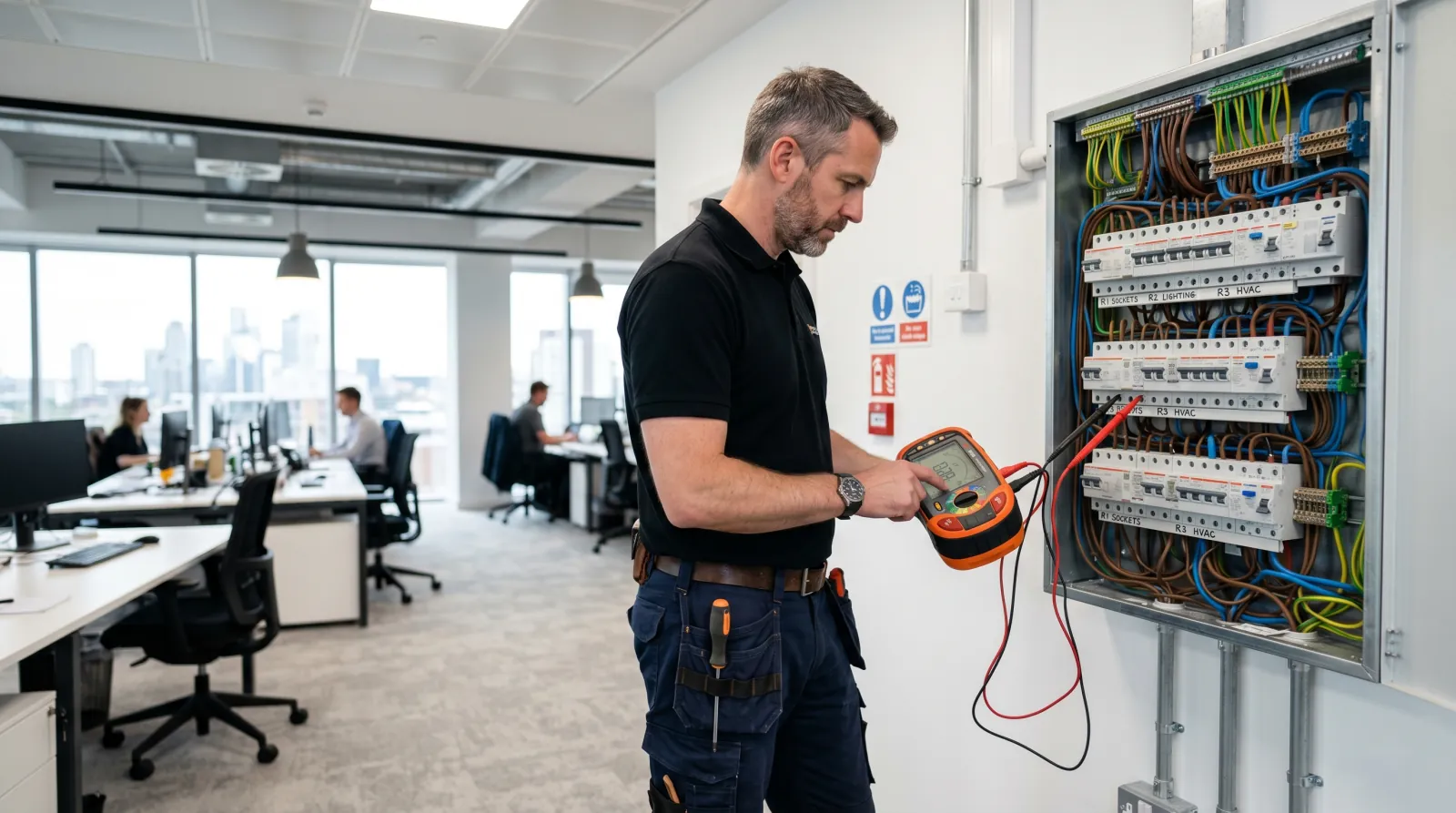
If you manage a commercial property, an Electrical Installation Condition Report (EICR) is the standard way to show that your fixed electrical installation is safe and properly maintained. That matters because you have a legal duty to keep it that way under the Electricity at Work Regulations 1989, and most insurers expect to see a current report. Many facilities managers book an EICR without being sure what it involves, what inspectors look for, or what a failure actually means.
This guide covers what to expect from a commercial EICR, so there are no surprises when the inspector arrives. If you need one, see our EICR testing service or our commercial electrician page.
What is a commercial EICR?
An EICR is a formal inspection and test of all the fixed electrical installations in a commercial property. That includes distribution boards, wiring, sockets, switches, lighting circuits, earthing arrangements and protective devices.
The purpose is simple: to confirm that the installation is safe, meets current standards and is fit for continued use. The finished report grades the installation and lists any defects that were observed.
How often does a commercial property need an EICR?
For most commercial premises an EICR is recommended every five years. The right interval can change depending on:
- The type of business operating in the premises
- The age and condition of the existing installation
- Whether the property has had a change of use or a significant refurbishment
- Any specific requirement from your insurer or lease
High-risk environments, such as industrial units with heavy machinery, catering facilities or sites with external electrical installations, may need more frequent inspections.
What do inspectors look for?
A qualified electrician carrying out a commercial EICR will inspect and test a wide range of elements.
Distribution boards and consumer units. Are they in good condition, correctly labelled and protected by suitable devices? Older fuse boards that do not meet current standards are commonly flagged.
Earthing and bonding. Correct earthing is critical in commercial environments. Inspectors check that metalwork is bonded and that the earth fault path is adequate.
Wiring condition. Cables are checked for deterioration, overheating, mechanical damage and incorrect installation. This matters most in older buildings where wiring may not have been updated for decades.
Circuit protection. Are circuits protected by correctly rated breakers or fuses? Overloaded circuits and wrongly rated protection are a common finding.
Sockets and accessories. Inspectors look for damage, incorrect installation and whether the accessories suit the loads connected to them.
Emergency lighting and fire alarm circuits. A full fire alarm inspection is separate, but an EICR will note any issues with the electrical supply to life safety systems.
Understanding the codes on your report
Every observation in an EICR is given a classification code:
- C1: Danger present. Risk of injury. Immediate remedial action is needed.
- C2: Potentially dangerous. Urgent remedial action is needed.
- C3: Improvement recommended. Not dangerous, but worth addressing.
- FI: Further investigation required. Something could not be fully assessed and needs follow-up.
A report is only satisfactory if it has no C1 or C2 codes and no outstanding FI items. A C1 or C2 finding means the installation has been classed as unsatisfactory and must be put right.
What happens if your property fails?
An unsatisfactory result does not mean your building is shut down, but it does mean you need to act on the findings. Your insurer may also need to know, as some policies require you to confirm that the installation is maintained to a satisfactory standard.
Remedial work is prioritised by code. C1 items should be dealt with straight away, and C2 items urgently. The timescale for C2 items depends on your insurance and your lease, so ask your electrician and your insurer what applies to you.
How long does a commercial EICR take?
It depends on the size of the premises and the complexity of the installation. A small commercial unit might be done in half a day. A large warehouse or multi-floor office could take several days. A good electrician will give you a realistic estimate after a survey.
Plan for some disruption, because testing means circuits are switched off for a short time. A good contractor will schedule the work around your operation to keep the impact on your business as low as possible.
Why NICEIC approval matters for your EICR
Only competent, qualified people should be inspecting commercial premises. NICEIC Approved Contractors are assessed against technical standards and are reassessed regularly. A report from an approved contractor carries weight with insurers, local authorities and future buyers or tenants.
Bowers Contracting is a NICEIC Approved Contractor and carries out electrical inspection and testing on commercial and industrial premises across Milton Keynes, Northampton and the surrounding area.
Get in touch for a no-obligation quote on your commercial EICR. Call 01908 040 294 or email mike@bowerscontracting.co.uk.