
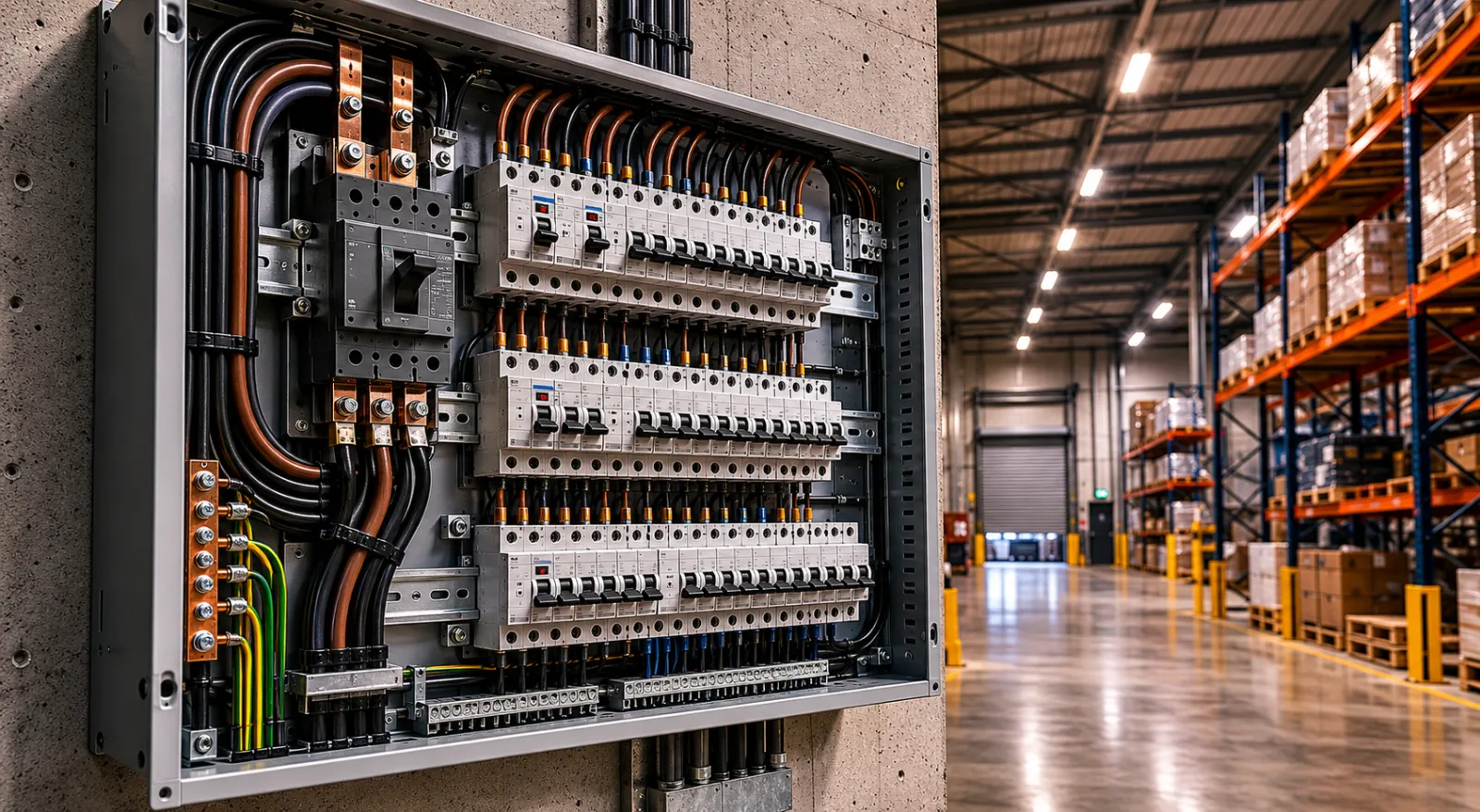
The distribution board, also called a DB, panel board or fuse board, is the control centre of your electrical installation. Every circuit in the building runs from it. Yet in many industrial and commercial premises it is one of the oldest and most neglected parts of the electrical system.
If your industrial unit is more than fifteen years old and the installation has never been upgraded, there is a real chance your board is no longer adequate for the demands placed on it, and it may not meet current regulations. See our industrial electrician page for the work we carry out.
What is a distribution board and what does it do?
A distribution board receives the incoming supply and distributes it to the circuits around the building. It also contains the protective devices, such as circuit breakers, fuses and RCDs, that disconnect a circuit automatically in the event of a fault or overload.
In an industrial setting the board needs to cope with significant loads: machinery, compressed air, HVAC, lighting across large floor areas and, increasingly, EV charging. The protective devices must be correctly rated for each circuit and must operate reliably when a fault occurs.
Signs that your distribution board needs replacing
It still uses rewirable or cartridge fuses. Modern boards use miniature circuit breakers (MCBs) and residual current devices (RCDs). If yours still uses fuses, it is almost certainly outdated.
The board is cramped or full. If there is no room to add circuits without removing existing protection, or circuits have been squeezed in by a previous electrician, the board is not being properly managed.
Circuits are not labelled, or the labels are old and wrong. Every circuit should be clearly and accurately labelled. Poor labelling makes fault finding slow and creates a safety risk.
You have unexplained tripping. Repeated tripping points to a faulty protective device or an overloaded circuit. Both need investigating.
Your installation has not been inspected for more than five years. Without a recent EICR you have no documented evidence that the installation is safe.
You are adding new equipment or loads. If you are installing machinery, EV charging or any other significant load, the board must be assessed to confirm it can take it safely.
The 18th Edition Wiring Regulations
The current standard is BS 7671, the 18th Edition, most recently amended in 2022. Older installations were built to earlier editions. An installation that complied when it was built does not automatically become unlawful when the regulations change, but new work and significant modifications must meet the current edition.
Recent changes that affect distribution boards include requirements around:
- Arc fault detection devices in certain applications
- Additional RCD protection on circuits
- Correct discrimination between protective devices
- Correct labelling and documentation
An upgrade is the right moment to bring the whole board in line with current standards.
What does a distribution board upgrade involve?
A commercial or industrial board upgrade follows a structured process:
- Assessment. A qualified electrician checks your existing installation, your current and planned loads and the condition of the board.
- Specification. The new board is specified with the right number of ways, the right protective device for each circuit and suitable RCD protection.
- Planned isolation. The supply must be isolated for the swap. In industrial premises this is planned carefully to limit disruption.
- Installation. The new board is fitted, circuits are reconnected and every protective device is correctly rated and labelled.
- Testing and certification. Every circuit is tested, and an Electrical Installation Certificate is issued.
A straightforward upgrade can often be completed in a day. Larger or more complex installations take longer.
The cost of not upgrading
An outdated or inadequate board is not only a compliance issue, it is a financial risk. Electrical faults caused by poor protection can lead to equipment damage, fire, production downtime and serious injury. Insurers also look closely at claims arising from electrical faults, and if your installation was not properly maintained, a claim can be disputed or reduced.
The cost of a board upgrade is modest compared with the cost of a fire, an equipment failure or a liability claim.
Bowers Contracting carries out commercial and industrial distribution board upgrades across Milton Keynes, Northampton and the surrounding area. As a NICEIC Approved Contractor, we test and certify all our work to current regulations.
Call 01908 040 294 or email mike@bowerscontracting.co.uk to arrange a free assessment of your existing distribution board.