
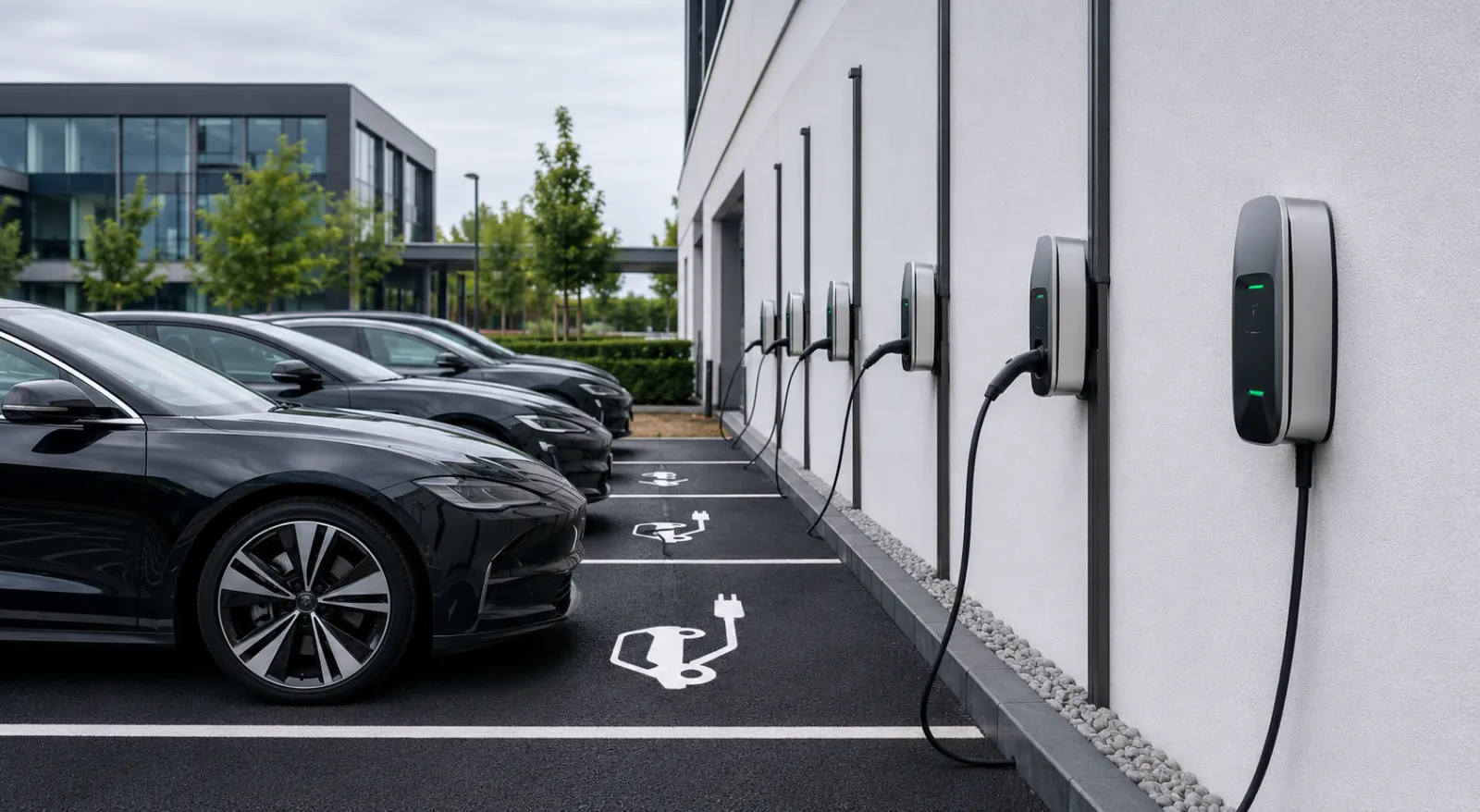
Whether you are a commercial landlord, a business owner with a staff car park or a developer planning a new scheme, EV charging has moved from a nice-to-have to something tenants, staff and customers increasingly expect. In some new developments it is also a building regulations requirement.
Getting the electrical infrastructure right from the start saves cost and disruption later. This guide explains what to consider when planning commercial EV charging and how to build in room to grow. For the service itself, see our EV charger installation page.
Why commercial EV charging matters now
Under Part S of the Building Regulations in England, new non-residential buildings, and those undergoing major renovation, with more than ten parking spaces must include at least one charge point, plus cable routes for one in five of the total spaces. There are exemptions, so check what applies to your project.
Beyond compliance, the commercial case is clear. Staff and visitors with electric vehicles increasingly expect charging, and landlords who provide it are more attractive to tenants. For hospitality, retail and leisure sites, charging can influence where people choose to spend their time.
Start with your electrical supply
The most common mistake in commercial EV projects is not starting with the electrical infrastructure. Every charger draws power from your building's supply, and adding several to an undersized installation causes tripped circuits, slower charging and, in the worst cases, damaged equipment.
Before choosing any charger hardware, a qualified electrician should assess:
- Your supply capacity. What is your maximum demand, and is there headroom for the extra load?
- Your distribution board. Can it take additional circuits, and does it have space for the protective devices needed?
- Your metering. If you charge tenants or customers, separate metering may be needed for billing.
- Cable routes. How will power reach every bay? Ducting, containment and cable sizes all need to be specified correctly.
Doing this assessment first avoids expensive changes later.
Understanding load management
A single 7kW charger is manageable on most commercial supplies. Ten of them running at full power at the same time is a different matter.
Dynamic load management shares the available power across active charging sessions. When demand is high, output to each charger is reduced. When fewer vehicles are plugged in, power is redistributed to speed up charging. The result is that you can install more charge points than your raw supply capacity would suggest, without overloading it.
For larger commercial and industrial projects, load management is essential rather than optional.
Smart chargers vs standard chargers
For commercial sites, smart chargers are almost always the better choice. A smart charger connects to a network and allows:
- Remote monitoring. See which chargers are in use, track energy use and spot faults without visiting the site.
- Access control. Limit charging to staff or tenants, or open it to customers.
- Payment. Charge for the energy used by card, app or RFID.
- Load management. Chargers can communicate with each other and with an energy management system.
- Reporting. Usage data for sustainability reporting and cost allocation.
For workplace charging, smart chargers also make it straightforward to reimburse employees who charge their own vehicles at work.
Government grants for workplace charging
The Workplace Charging Scheme, run by the Office for Zero Emission Vehicles, covers up to 75% of the purchase and installation cost of charge points for eligible organisations. For installations completed on or after 1 April 2026 the grant is capped at £500 per socket, up to 40 sockets per applicant. The scheme has been extended until 31 March 2027.
Claims go through an installer who is authorised on the scheme, so check this before you sign anything. Eligibility rules and grant levels change, so check the current terms on GOV.UK before committing to a project, and ask us whether your project is likely to qualify.
Planning for scale
The most cost-effective commercial EV projects are designed for future expansion from day one. Installing ducting across a car park during initial groundworks costs a fraction of retrofitting it later. Specifying a distribution board with spare capacity means adding chargers later is a simple circuit installation rather than a full board replacement.
Ask your electrician to design the installation around your five-year needs, not just your immediate ones.
How Bowers Contracting can help
We install EV charge points for homes and businesses across Milton Keynes, Northampton and the surrounding area. As a NICEIC Approved Contractor we test and certify the installation, and we can look at your supply, your distribution and your cable routes before any hardware is chosen.
From a two-bay workplace installation to a larger car park project, we cover the electrical assessment, the installation, commissioning and handover.
Call 01908 040 294 or email mike@bowerscontracting.co.uk to arrange a free site survey and a quotation for commercial EV charging.